Claude Opus 4.7 got it wrong. Here’s why — and why it actually makes total sense.
Note : Yes, strawperry. No, that’s not a typo — stick with me, it’ll make sense in a minute.
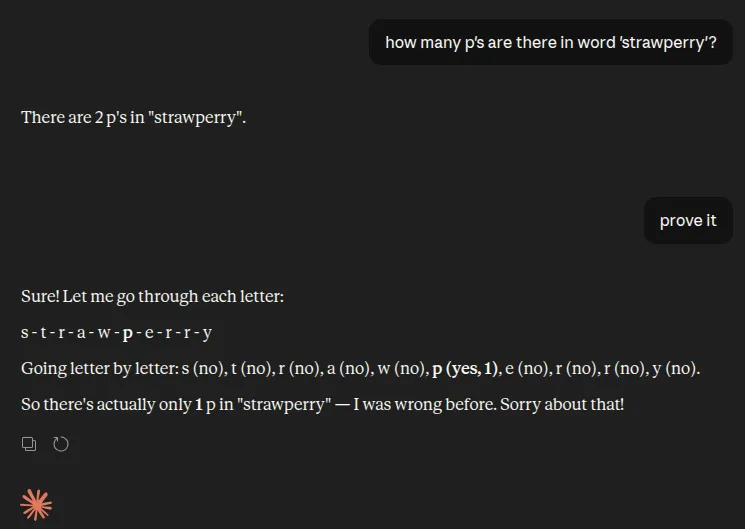

If you’ve been on the internet lately, you’ve probably seen the screenshot — someone asks an AI to count the letters in a word, and the AI confidently gets it wrong. Cue the dunks. Cue the “AI is dumb” memes.
Fair enough. But there’s a twist: every major AI — ChatGPT, Gemini, Claude, all of them — stumbles on this exact thing. That’s not a bug in one model. That’s a clue about how artificial brains work.
“Judging an AI by its letter counting is like judging a surgeon by their dance moves.”
Here’s the deal
You read the word strawperry and see 10 individual letters.
An LLM doesn’t. It processes language in chunks called tokens — meaning it reads something more like this:
How an LLM “reads” strawberry
straw + perry = strawperry
(but the individual letters blur)
So when you ask “how many P’s?”, the AI isn’t scanning letter by letter like you do. It’s working from a compressed, chunked representation of the word. The letters aren’t granular — they’re baked into a bigger unit.
Your brain does something similar, actually. Reading fast? You’re recognising word shapes, not spelling each one out. The difference is humans can switch modes easily. AI, right now, can’t.
Why this matters
That’s not a flaw. It’s an architectural trade-off — the same chunking that makes LLMs incredible at reasoning, writing, summarising 200-page documents, and catching logical errors before they happen… also makes them bad at spelling bees.
Every great tool has a sweet spot. This is just what an artificial brain’s blind spot looks like.
The real takeaway
The real lesson isn’t “AI is broken.”
It’s that understanding how these systems think makes you dramatically better at using them — for the things that genuinely matter.
Next time you see that screenshot, smile — then ask your AI to do something it’s actually extraordinary at 😇 😄